
Unleash Your Inner Wordsmith: The Adjectives Quiz Awaits!
Adjectives Quiz
Here’s a multiple-choice adjectives quiz where the task is to complete each sentence with the correct adjective derived from the given noun. Goog luck with my adjectives quiz!

Adjectives Quiz: Drag the Words
The difference between American football and soccer …

Adjectives Explained
Read first and then try my adjectives quiz.
Adjectives are words that describe or modify nouns or pronouns by providing additional information about their qualities, quantities, or states. They help make sentences more precise and expressive.
Types of Adjectives:
Descriptive Adjectives
These adjectives describe the characteristics or qualities of a noun, such as size, color, shape, or emotion.
Example: The big house, a happy child.
Quantitative Adjectives
These indicate the quantity or amount of something, but do not give an exact number.
Example: Some people, much time, few options.
Numerical Adjectives
These provide an exact number or order of the noun.
Example: Two apples, the first place.
Demonstrative Adjectives
These adjectives point to specific nouns. The most common are “this,” “that,” “these,” and “those.”
Example: This book, those shoes.
Possessive Adjectives
These indicate ownership or relationship. Common possessive adjectives include “my,” “your,” “his,” “her,” “its,” “our,” and “their.”
Example: My car, their house.

EXAMPLE OF ADJECTIVES (in the picture)
A young woman with brown hair eating a delicious cake and drinking from a white mug.
Interrogative Adjectives
These are used in questions to modify nouns. They include “which,” “what,” and “whose.”
Example: Which book are you reading?
Comparative Adjectives
Used to compare two things, often by adding “-er” to the adjective or using “more.”
Example: Taller than, more beautiful.
Superlative Adjectives
Used to describe the highest degree of a quality, usually by adding “-est” to the adjective or using “most.”
Example: The tallest building, the most beautiful flower.
Formation of Adjectives
From NOUNS
Many adjectives are formed from nouns, often by adding suffixes like “-al,” “-ous,” “-ic,” or “-ive.”
Examples: Nation → National, Person → Personal, Economy → Economic.
From VERBS
Some adjectives are derived from verbs by adding suffixes like “-able” or “-ed.”
Examples: Read → Readable, Interest → Interested.
Position of Adjectives
BEFORE THE NOUN
Adjectives usually come before the noun they modify.
Example: A beautiful painting.
AFTER LINKING VERBS
Adjectives can also follow linking verbs like “be,” “seem,” “become,” etc., to describe the subject.
Example: The sky is blue, She seems happy.
Why Do We Need Adjectives?
Well, try seeing them as something sparkling or eye-catching in your written and spoken English, something that can create interest and a little bit of fun. Seriously, imagine English without them: a’man’ is just a’man’, a ‘week’ is just a ‘week’ – it sounds so dull, doesn’t it? But when you add some adjectives, you get a ‘hard-working man’, or perhaps an ‘easy-distracted man’. And then put it all together; you get something wonderful: ‘the normally hard-working yet, on occasion, easy-distracted man sat staring at his monitor’. Bingo! Now the sentence you’ve created has ‘colour’, which not only engages the readers more and, to be honest, but also is the hallmark of any good wordsmith.
Anyone who knows how to write will tell you that adjectives aren’t merely decorative but essential choices in effective language usage. Simply put, by adding that ‘bit of spice’ to your writing and speaking, a well-chosen adjective can help to convey mood and make your descriptions of people, places and moments more precise. Full stop!
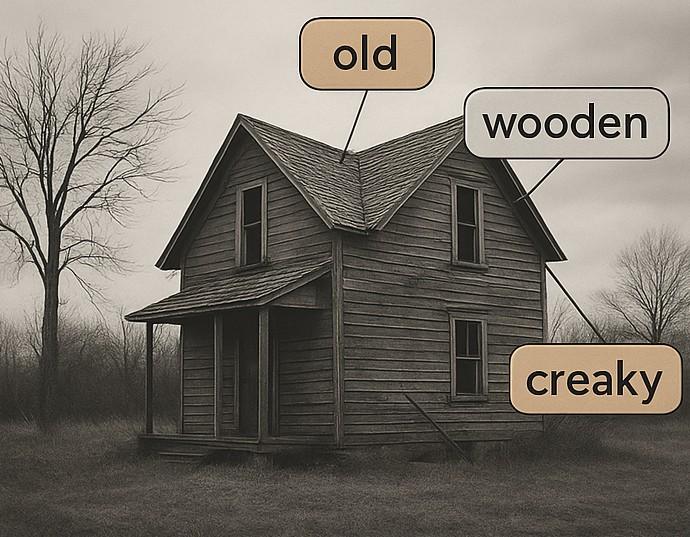
Still don’t believe me? Think for a minute about the following: ‘a house’ and ‘an eerie, abandoned house with creaky floorboards’. The first sounds like a place that you might want to visit or not, as the case might be. While the second sounds like a spooky Airbnb test of bravery!
To sum up, adjectives are great; they really add much-needed colour, feeling, and, most of all, attitude to your writing. And without them, your English is a bland soup of nouns and verbs, so think on, dear, dutiful students.
Try something different then adjectives quiz
There are more quizzes to choose from. Please click on the buttons below.