
English Grammar Articles – A, An, The – Explained in a Fun Video Lesson
English Grammar Articles
Articles are words that define a noun as specific or unspecific.
In English, there are three articles:
the (definite), a/an (indefinite), and zero article (no article).
Watch the video below and try to identify the articles used.
Articles – Grammar Overview
Definite Article: the
Used to refer to a specific item or items known to both the speaker and listener.
Example: the knife, the tent
Indefinite Articles: a/an
Used to refer to a non-specific item or items.
Example: a knife, an island
Zero Article: no article
Used with plural and uncountable nouns when talking about things in general.
Example: water, matches
English Grammar Articles in the Video
John: “Alright, Sarah, we need to pick ten items to take to a desert island.”
Sarah: “How about a knife? It’s essential for survival.”
John: “And we definitely need some water. We can’t survive without it.”
Sarah: “Let’s take a tent too. We’ll need shelter.”
John: “What about food? We should have something to eat.”
Sarah: “Let’s add a box of matches as well. We’ll need fire for cooking.”
John: “A first aid kit is also important. Safety first.”
Sarah: “A fishing rod could help us catch food.”
John: “We should also take a map of the island. It could help us navigate.”
Sarah: “How about a flashlight? It will be useful at night.”
John: “A book could help pass the time.”
Sarah: “So, our list is: a knife, water, a tent, food, matches, a first aid kit, a fishing rod, a map of the island, a flashlight, and a book.”
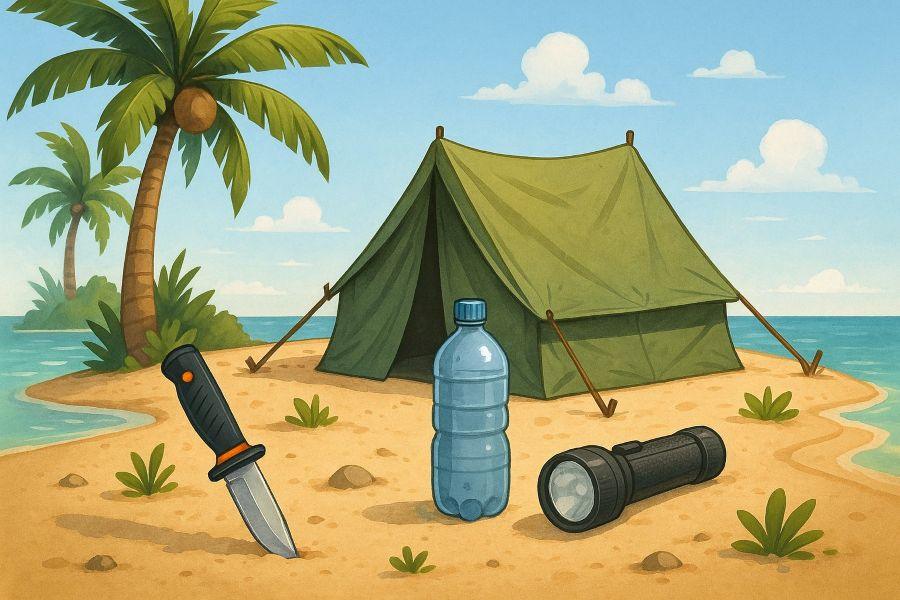
SOME OF THE OF ARTICLES EXPLAINED:
food = zero article, uncountable noun
a tent = indefinite, non-specific tent
a map of the island = indefinite, non-specific map | definite, now specific island
water = zero article, uncountable noun
Practise Your Articles
Fill in the blanks with English grammar articles a, an, the, or leave blank (zero article) as needed:

- We need to bring ____ flashlight.
- She packed ____ box of matches.
- He wants to take ____ map of ____ island.
- We must not forget to bring ____ water.
- They decided to carry ____ first aid kit.
- What about ____food? We should have something to eat.
Show me the answers
- a
- a
- a, the
- (zero article)
- a
- (ZERO ARTICLE)
Why do students struggle with English grammar articles?
Non-English speakers often struggle with English grammar articles because many languages either don’t have articles or use them very differently. Here are a few common reasons:
Absence of articles in their native language: Some languages, like Russian, Chinese, Japanese, and Korean, don’t use articles at all. Speakers of these languages have to learn not only when to use an article in English but also which article to use, which is challenging without an equivalent concept in their native language.
Different article rules: Even for speakers of languages that do use articles, the rules might differ. For instance, Romance languages like Spanish and Italian use articles but in ways that don’t always align with English. English requires articles for many singular nouns, but other languages might drop articles in similar contexts, which can lead to errors when learners transfer their native habits to English.
Complexity of English grammar articles rules: English articles are used in varied and nuanced ways, depending on specificity, countability, or prior mention. For example, “a” and “an” introduce something new or general, while “the” specifies something known or already mentioned. These distinctions can be subtle and tricky for learners to grasp, especially because article usage also depends on context.
Intangible concepts: Articles can also express abstract ideas like definiteness (e.g., “the sky” refers to a known, singular concept), which isn’t obvious in some languages. These abstract uses are challenging for non-native speakers to internalize, especially in more advanced contexts, like discussing concepts or making generalizations.
Practice and exposure can help, but even advanced speakers sometimes struggle, as article use in English is intricate and often highly idiomatic.
Completed the video lesson on articles already?
Please go back to the video lessons page and select another video lesson.